Dival Intelligence Platform — Building trusted national intelligence for better decisions.

Dival AI

Ask a question. Get an answer counted from real records.

Type what you want to know and DIP answers it — companies over a threshold, what moved this week, who to chase, why one business reads as risky. The assistant reads the question; the platform counts the answer from records you are already entitled to see. Every figure can be opened and checked.

Which businesses owe us more than 20,000 across multiple institutions?
Ask DIP
What changed in our portfolio this week?Which accounts should collections prioritise?Why is this business high risk?

CREDIT ANALYST

“Why is Grand Horizon SARL considered high risk?”

Dival AI: Two institutions report an obligation. Your own file holds three records, the oldest unpaid for 412 days, and the DIP Risk Indicator reads 67 of 100 — driven by the age of the obligation and by more than one institution reporting it. Fraud indicators and dispute history are not scored at all, and the answer says so rather than reporting them as clear.

PORTFOLIO MANAGER

“Which businesses owe us more than 20,000?”

Dival AI: Fourteen companies, 640,200 USD owed to you, four of them unpaid for over a year. That total is your exposure and not the market's — DIP never discloses what another institution is owed. Narrowing to companies more than one institution reports would cost fourteen of your hourly inquiries, and the answer quotes the price before spending it.

Grounded by design: the assistant chooses from a fixed set of questions and never writes its own query, so it can only ever reach data you could already see. It shows you what it understood before it answers, and names anything it deliberately left out.

The Platform

Everything below is running today.

Not a roadmap. Each of these is in the product now, in French and English, with row-level isolation between institutions and an audit trail behind every action.

Ask and find

  • Ask DIP in plain language and get figures counted from records
  • Universal search across your own book by name or identifier
  • Consolidated profiles for businesses and individuals
  • Evidence packs: one company, its file, its verdict, and what is deliberately missing

Exchange

  • Cross-institution inquiry returning a status and a count — never a name, never an amount
  • Declare a default, with a reporting floor below which nothing enters the registry
  • Rate-limited and purpose-stamped: every question recorded with why it was asked
  • Watchlists that re-ask nightly, and alerts graded so a night of good news does not read like a night of bad
  • How large the network is, told to every participant and resolvable to none: institutions, subjects, and the businesses owing more than one

Understand risk

  • The DIP Risk Indicator, every weight published beside the figure
  • Exposure by ageing band and currency, computed server-side
  • Executive intelligence: your book today and thirteen months of activity
  • Anomaly detection over the audit trail, including abuse of DIP itself

Get data in

  • CSV and Excel import, raw rows kept immutable with provenance on every record
  • A mapping you define and version, against whatever header your export actually has
  • Import keyed on your own account numbers, or on nothing but a name
  • Take a delivery back and every record derived from it goes with it

Resolve identity

  • Candidate matches scored on published signals and decided by a person
  • Register numbers read for what they are: reissued when a company changes its statutes
  • Sector, city and address compared where an operator supplies them
  • Nothing merges automatically, at any confidence

Stay defensible

  • Subject access, dispute, correction and erasure on statutory deadlines
  • Retention that deletes rather than hides, clocked from when the debt fell due
  • A permissions catalogue read from the code's own guards
  • Settings that state where every configured value came from
National Intelligence Infrastructure

From fragmented records to a trusted national intelligence layer.

DIP is designed to become a nationally trusted infrastructure where approved institutions can securely contribute, validate, and consult risk intelligence while retaining ownership of their operational data.

SEARCH

Universal Entity Search

Search businesses and individuals across available participating data sources using names, identifiers, phone numbers, account references, and other approved attributes.

Explore search →
ID

Identity Resolution

Match inconsistent names, aliases, identifiers, phone numbers, and historical records to create a trusted entity profile with confidence scoring.

Explore identity →
RISK

Risk Intelligence

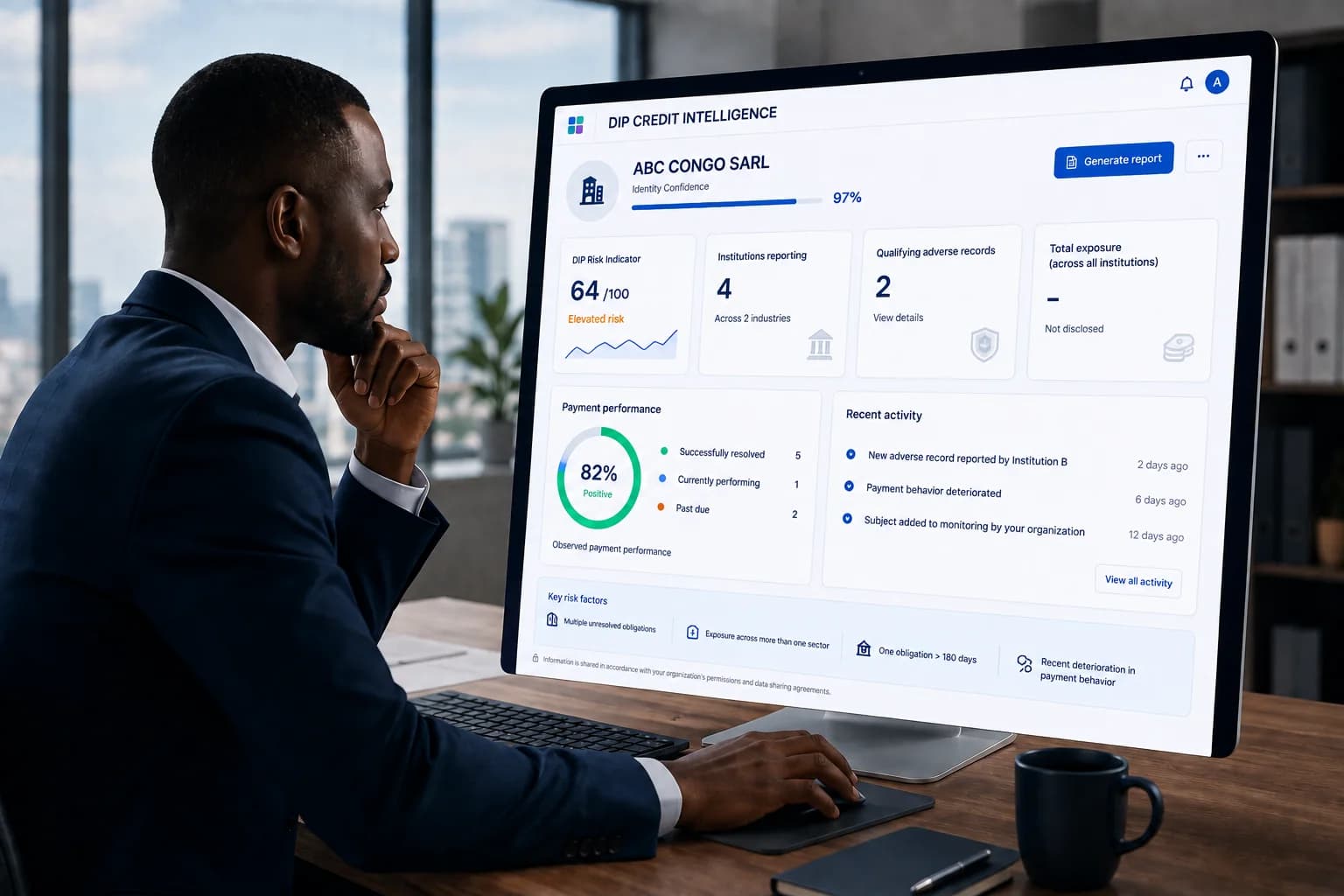
Combine payment behaviour, aging, exposure, how many institutions report, and how firmly the subject was identified into one figure — with every weight published, and the two factors the platform refuses to score named beside it.

Explore risk →
FRAUD

Fraud and Anomaly Detection

Surface unusual search behaviour by an institution's own users, repeated defaults, conflicting information, and data-quality problems. Not duplicate identities: the registry's uniqueness rules make one document under two subjects impossible, so a detector for it would report nothing forever.

Explore fraud →
Trusted Data Exchange

From spreadsheet to shared intelligence network.

Start with secure file ingestion today. Evolve toward real-time APIs and multi-institution intelligence as participating organizations connect.

  1. 01

    Ingest

    Excel, CSV, and secure uploads — every raw row kept immutable, with provenance.

  2. 02

    Validate

    Schema checks, missing values, formats, reconciliation, and source quality.

  3. 03

    Resolve

    Normalize names, detect duplicates, match entities, and assign confidence.

  4. 04

    Enrich

    Exposure, aging, how many institutions report, identity confidence, and thirteen months of trend.

  5. 05

    Decide

    Search, Ask DIP, risk indicators, evidence packs, watchlists, dashboards, and human review.

The Exchange Boundary

Institutions share a verdict, not their books.

The reason a competing operator will join is not what the exchange reveals. It is what it refuses to.

What an enquiring institution receives

  • Whether an adverse record exists, and its status
  • How many institutions hold one
  • How confident the identity match is
  • Fraud and duplicate-identity signals

What it is never told

  • The amount owed
  • Which institution reported it
  • Account references, tariffs, usage, or any operational data
  • Anything at all about a record while it is under dispute

Enforced by the database, not by the application. A participant's rows are unreadable to another participant's connection; the exchange relaxes reads for one specific question and never relaxes writes.

Every inquiry is rate-limited and recorded with a stated purpose. Each one is individually legitimate — the aggregate is what turns a lookup service into a bulk export.

Risk Intelligence

A risk profile built from evidence, not a black box.

The DIP Risk Indicator is a sum of stated factors, each published with its weight. It is an indicator rather than a credit score, and it says so: 0 is no adverse information and 100 is the most the platform can observe.

  • Payment behaviour
  • Debt aging
  • Reporting institutions
  • Identity confidence
  • Fraud indicators
View sample report
DIP Risk IndicatorIllustrative
Indicator
67 / 100
Assessment
Elevated risk
Model
DIP-RI-3

Factors influencing assessment

Payment behaviourHigh risk
Debt agingHigh risk
Reporting institutionsModerate
Identity confidenceStrong
Fraud indicatorsNot assessed
Outstanding exposureLow
Dispute historyNot assessed

Two factors are deliberately never weighed, and the reason for each is printed beside the assessment: disputes, which are already withheld from every answer the exchange gives, and fraud indicators, whose signal the registry's own uniqueness rules make impossible. Outstanding exposure joined them until August 2026, when counsel confirmed the operator files are in US dollars; it is now weighed in four bands wide enough that no sequence of readings recovers the amount.

DIP Credit Intelligence, in design — a pre-credit check assembling identity, network signals and the risk indicator for a lender.
Entity Intelligence

Business and individual intelligence in the same platform.

Different users need different evidence. DIP maintains separate profiles, permissions, signals, and reporting for businesses and individuals.

B2B

Business Intelligence

Search organizations, consolidate operator records, review payment exposure, aging, account status, identifiers, business relationships, and risk indicators.

Business profile →
INDIVIDUAL

Individual Intelligence

Resolve identities using approved personal identifiers and historical records, surface payment behaviour and how many institutions report the person, and support responsible onboarding decisions.

Individual profile →
MONITORING

Portfolio Monitoring

Watchlist existing customers and portfolios, swept nightly for new debt, aging changes, write-offs, disputes, and material risk changes.

Portfolio monitoring →
National Trust Framework

Designed to become a trusted reference across institutions.

DIP is not another isolated database. Its long-term role is to provide a governed national intelligence network that banks, telecom operators, insurers, utilities, enterprises, and authorized public institutions can rely on when assessing identity, exposure, and risk.

TRUSTED SOURCES

Verified Institutional Data

Intelligence is derived from approved participating sources, with provenance retained for every record.

GOVERNANCE

Shared Rules, Clear Ownership

Participants retain ownership of their operational data while DIP applies governed sharing and access rules.

AUDITABILITY

Every Search Accountable

Searches, reports, exports, and risk reviews are designed to be logged and auditable.

NATIONAL SCALE

Built to Grow Nationwide

The architecture supports growth from initial telecom datasets to a broader multi-industry national intelligence ecosystem.

Industry Solutions

One platform. Different decisions.

DIP serves as the shared intelligence foundation while each industry receives workflows and risk views tailored to its own operating model.

BANK

Banking and Lending

Customer due diligence, business search, identity matching, pre-credit risk indicators, portfolio watchlists, and behavioural anomaly detection over your own users.

Banking edition →
TIX

Telecom Intelligence Exchange

Shared telecom debt intelligence, aged exposure, how many operators report a subject, account history, identity resolution across operator books, and onboarding risk support.

TIX module →
INS

Insurance

Identity verification, business due diligence, anomaly indicators, customer relationships, and configurable underwriting support signals.

Insurance edition →
UTIL

Utilities and ISPs

Assess service applicants, monitor unpaid balances, identify repeat defaults, and share approved risk information across participating networks.

Utilities edition →
B2B

Enterprise Trade Risk

Search companies before offering credit, contracts, equipment, postpaid services, or supplier terms. Monitor strategic counterparties continuously.

Enterprise edition →
GOV

Public Sector

Use governed identity, business, and risk intelligence for authorized public-sector verification, licensing, collections, and program-integrity workflows.

Public sector edition →
Portfolio Intelligence

Understand exposure before it becomes a loss.

Dashboards help decision makers see concentrations, aging, operator exposure, high-risk entities, recovery priorities, and data quality across the portfolio.

EntityTypeExposureRiskStatus
Grand Horizon SARLBusiness$184,000ModerateReview
Atlas DistributionBusiness$96,200HighActive
Customer 01984Individual$2,480LowClear
Regional Services LtdBusiness$61,500HighMonitor

Illustrative figures. DIP shows an institution its own exposure in full and never another institution's — a real version of this table is your book, not the market's.

The People in the Registry

A national registry is only defensible if the people in it can answer back.

A shared bad-payer list decides who can open a line, take a loan, or win a contract. That is real power over people who did not choose to be in it, and the rights below are built rather than promised.

Ask what is held

A person can obtain their whole file across every participating institution — not only the one whose office they happened to walk into.

Dispute, and be suppressed while it is examined

A contested record stops being reported to other institutions the day the dispute is raised. Before the decision, not after: the harm of being wrongly listed accrues every day the listing stands.

Be forgotten on a clock

Every record carries an expiry set from the date the obligation fell due, never from the date it was reported — so reporting a debt late cannot keep somebody listed for longer. When it passes, the record is deleted rather than hidden.

Not be added by asking

Looking somebody up never creates them. Somebody who comes forward to ask whether they are listed does not become listed by asking.

Behind an entry in this registry is a household. That is the whole reason the rights above are built rather than promised — and the reason a registry that works matters at all, in a market where most people have no credit file to be judged on.

Retention periods are configuration, not constants, because they are legal periods. Counsel advised five years in August 2026 and that is what the platform applies; the settings screen names the origin of every value, and the one figure nobody has yet been asked about still says so.

Governed by Design

Intelligence without surrendering control.

Each participating institution owns its operational data. DIP decides who may read what, records every access with the purpose it was given, and keeps one institution's records out of another's reach at the database.

SECURITY

Role-Based Access

Users see only the data and actions permitted for their organization and function.

AUDIT

Complete Traceability

Every inquiry, declaration, import and decision is recorded — with the account that did it and the purpose it was given. Rows are appended, never edited.

PRIVACY

Data Minimization

Share the intelligence required for a decision without exposing the underlying operational data.

HUMAN REVIEW

Decision Support

DIP supplies the evidence and publishes how it was weighed. The institution decides.

Turn the data you already have into intelligence you can act on.

Start with existing telecom spreadsheets. Add new institutions, APIs, and risk capabilities as the network grows.